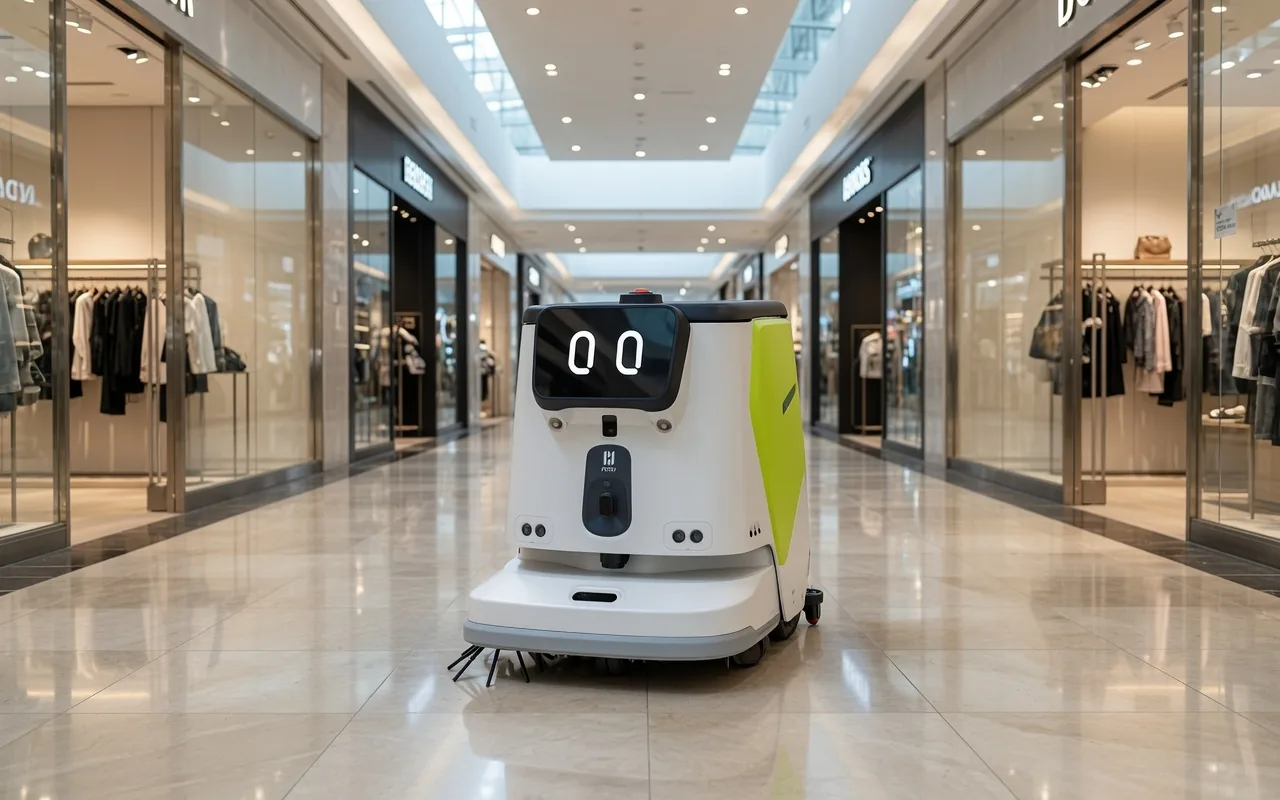
The price on a cleaning robot is the first line of its cost, not the whole of it. Cleaning robot total cost of ownership adds up everything you pay to own and run the machine over the years you use it: the robot, its dock and accessories, installation, wear parts, service, running costs and the cost of financing, minus what the robot is still worth at the end. This guide walks through each line and finishes with a five-year worksheet you can fill in with your own numbers.
What TCO includes
A useful TCO has two kinds of line. One-time costs are paid when the robot arrives: the machine, its docking station, any accessories, and installation. Recurring costs run for as long as you own it: wear parts, service, electricity and water, and, if you finance, the cost of the financing itself. At the end of the period you subtract what the robot is still worth to you.
The total on its own does not tell you whether to buy. It is the cost side of the decision. The other side is what the robot returns, which you can model separately in our ROI calculator and our guide to calculating cleaning robot ROI.
Purchase price
Tovrana sells the PUDU lineup at published manufacturer MSRP. These are the cleaning robots, exactly as listed on our pricing page:
| Robot | Public MSRP |
|---|---|
| SH1 | $3,800 |
| MT1 Vac | $20,000 |
| CC1 | $22,000 |
| CC1 Pro | $24,000 |
| MT1 Max | $25,000 |
| BG1 | $36,999 |
| BG1 Pro | $39,000 |
The MSRP covers the robot itself. It does not include installation or accessories, which are the next two lines of the total. If you are sizing more than one machine, multiply the MSRP by the number of robots before you go further.
Dock, accessories, and installation
The docking station is often what turns a capable robot into an unattended one. The Self Cleaning Docking Station charges a scrubber, refills and drains water, and cleans the brushes and squeegee between runs, which is why we treat it as part of the cost of a CC1 Pro rather than an extra. Other add-ons depend on your building: an Elevator IoT Module for multi-floor routes, a Mobile Water Station where there is no fixed plumbing, or an additional battery for around the clock schedules. The full range is on our accessories page, and accessories are quoted as part of your package.
Installation is quoted per site, because it depends on your floors, your layout and the accessories you choose. It covers the work that gets a robot running properly: a site survey, mapping, on-site deployment, zone and schedule programming, and staff training.
Wear parts and consumables
Brushes, filters, pads and squeegee blades wear with use, as they would on any cleaning machine. They are tracked against the robot's usage hours, so a robot that cleans every night needs them more often than one that runs twice a week. Wear parts are quoted per site, built from your own cleaning schedule rather than a generic figure.
Two things are worth knowing when you budget this line. Consumable parts that wear with use are outside the manufacturer warranty, so they belong in your own budget from day one. And fresh parts are what keep the robot performing at the level you bought it for, so this is not a line to trim. Our guide to cleaning robot maintenance covers the daily routine and how parts are tracked.
Service plans and support
Every robot Tovrana sells is covered by its manufacturer's limited warranty. The Sparkoz TN10-PRO carries 2 years and the TN70-PRO 3 years, parts only on both. PUDU robots typically carry 12 months from activation or purchase, whichever comes first. The exact terms for your model are confirmed in writing with your quote, and the warranty page sets out what is and is not covered.
Extended warranty options are available for Sparkoz and for PUDU. PUDU CARE extended warranty and service plans are available for purchase, adding up to 2 additional years of coverage on eligible models. Plans are quoted per site, and Tovrana helps you choose one and adds it to your package. Beyond the warranty, you contact Tovrana first: we troubleshoot remotely first, and when a robot needs hands-on service we coordinate it for you. Our support page covers the details.
Financing cost
If you finance, you own the robot from day one. Tovrana prepares the package for your own bank or a third party lender, a typical lender decision takes 5 to 10 business days, and the lender funds the full package on verified installation, so nothing is owed for the equipment until your robots are installed and confirmed working.
The cost of financing is the extra you pay for spreading the cost over time. Your lender's offer gives you the two numbers you need:
Financing cost formula
Cost of financing = (monthly payment × number of payments) minus the amount financed. Enter that figure as its own line in the worksheet below. The monthly payment itself depends on the robots and how many you deploy, the term your lender offers, the service level you choose, and any accessories in the package.
Your lender sets the term and the payment. Our financing page walks through the process step by step.
If you lease instead, the monthly payment is the line to enter, over a term of 24 to 63 months, with other lengths on request, and residual value is not yours to count, because at the end of the term you return the robot, renew, or ask us about buying it. See how robot leasing works.
Downtime and residual value
Two lines are easy to leave out. The first is downtime. A robot that is not running is not returning anything, so the cost of a stopped day is the cleaning you have to cover another way. Light daily upkeep, parts replaced before they fail, remote troubleshooting first and a service plan sized to your fleet all keep this line small. Put an honest allowance in rather than zero.
The second is residual value: what the robot is still worth to you at the end of the period. You might keep running it, move it to another site, or sell it. If you are not sure, enter zero. That keeps the estimate conservative, and anything the robot is worth later is a bonus.
A five-year TCO worksheet
Fill in each line for your own site. The middle column tells you what goes in it. Lines marked quoted per site come from your Tovrana quote, and the only fixed figures are the published MSRPs.
| Cost line | How to fill it in | Your five-year figure |
|---|---|---|
| A. Robot purchase | MSRP × number of robots (for example, CC1 Pro at $24,000 MSRP) | |
| B. Dock and accessories | Quoted per site as part of your package | |
| C. Installation | Quoted per site | |
| D. Wear parts and consumables | Quoted per site, from your cleaning schedule, for five years | |
| E. Service plan (PUDU CARE) | Quoted per site, if you add one | |
| F. Running costs | Electricity and water per year × 5 | |
| G. Downtime allowance | Your estimate of cleaning covered another way when the robot is stopped | |
| H. Cost of financing | (Monthly payment × number of payments) minus amount financed; zero if you buy outright | |
| I. Residual value | What the robot is worth to you at year five; zero if unsure | |
| Total cost of ownership | A + B + C + D + E + F + G + H minus I | |
| Cost per year | Total cost of ownership ÷ 5 |
Set the cost per year against what the robot returns each year and you have the whole decision on one page.
Buying outright vs financing over five years
Run the worksheet twice. Buying outright sets line H to zero, but the full purchase leaves your capital on day one. Financing adds line H and keeps that capital free, with a predictable monthly figure you can set directly against the value the robot returns each month. The other lines are the same either way, and with financing you own the robot from day one, so the difference between the two totals is the cost of financing.
Which is better depends on what your capital would otherwise do, and that is a question for your own planning. Tax timing can matter too, and your accountant is the right person to confirm what applies to your business. For the wider question of whether a robot pays off at your site, see are cleaning robots worth it, and for the price side in more depth, our commercial cleaning robot cost guide.
Frequently asked questions
What is the total cost of owning a cleaning robot?
The robot itself plus its dock, accessories, installation, wear parts, service, and the cost of financing, minus what it is worth at the end. The worksheet on this page lets you fill each line in.
How much does cleaning robot maintenance cost per year?
Wear parts and service are quoted per site. Brushes, filters, pads and squeegee blades are replaced on a rhythm set by usage hours, so the yearly figure depends on how often the robot runs. PUDU CARE service plans can be added to your package and are quoted per site too.
Is installation included in the MSRP?
No. The published MSRP covers the robot itself. Installation is quoted separately for your site, and docks and other accessories are quoted as part of your package.
Does the warranty cover wear parts?
No. PUDU's warranty excludes consumable parts that wear with use, such as rubber blades, brush kits, pad kits, and squeegee assemblies, so budget them as their own line.
Do I own the robot if I finance it?
Yes. With financing through your own bank or a third party lender, you own the robot from day one, and nothing is owed for the equipment until your robots are installed and confirmed working.