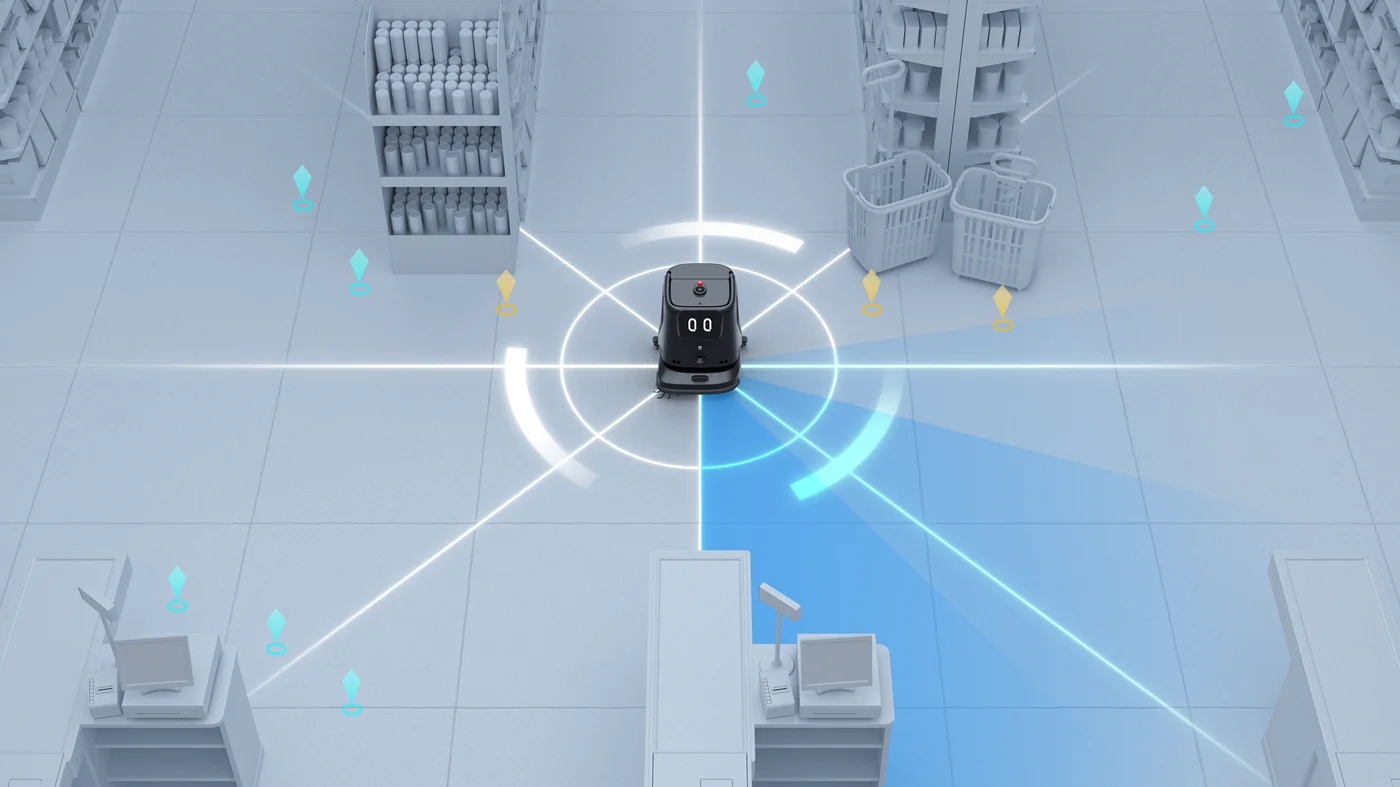
Are cleaning robots worth it? For some facilities, clearly yes. For others, not yet, and a good supplier should tell you which one you are before you sign anything. This guide sets out when a commercial cleaning robot pays off, when it does not, a five-question test you can run on your own site, and how to check the math with your own numbers instead of someone else's.
When a cleaning robot pays off
A robot earns its place when there is a lot of repetitive, open, hard floor that someone cleans on a schedule. Lobbies, corridors, sales floors and aisles are the classic examples: the same route and surfaces every day, which is exactly the work a robot does well.
The second condition is hours. A robot that runs a full cleaning window every night, and ideally a second cycle during the day, spreads its cost across far more cleaned floor than one that runs for an hour. A self cleaning dock matters here, because a robot that refills, drains and recharges on its own can keep working without a person standing by.
The third condition is that the people it frees have somewhere better to go. When the open floor is handled, your team can spend its time on restrooms, edges, spills and the detail work only people can do. We cover that side in our piece on cleaning robots and the labor shortage.
When a cleaning robot does not pay off
The wrong robot is expensive at any price. These are the sites where we usually advise against an autonomous robot, or at least against starting with one:
- Small floors. If the open floor takes a person a short time to clean, there is little routine work for a robot to take over, and its capacity sits idle.
- Cluttered floors. Tight rooms, dense furniture, cables and floors that are never clear at cleaning time leave a robot with short routes and constant interruptions.
- Short hours. A site cleaned for an hour or two a day, a few days a week, rarely gives a robot enough work to justify its cost.
- Mostly detail work. If your cleaning time goes on restrooms, counters, glass and edges rather than open floor, a floor robot is solving the smaller part of the problem.
None of that means the answer is to do nothing. For a small or awkward space, an operator guided machine is often the better fit. The PUDU SH1 is a smart upright scrubber dryer that a member of your team runs by hand, cleaning and drying a floor in a single pass, at an MSRP of $3,800.
A five-question test before you buy
Answer these about your own site. If you can say yes to all five, a robot is very likely worth a closer look. Two or more noes usually mean the site is not ready yet.
- Do you pay for routine floor cleaning today, in hours you can count? Pull them from schedules or timesheets, not from memory.
- Is most of that work on open, hard floor? Scrubbing, sweeping and vacuuming of clear areas, not detail work.
- Is the floor clear when cleaning would happen? Overnight or between shifts, with routes a robot can follow.
- Can the robot run long enough each day? A full nightly window, and better still a daytime cycle too.
- Does someone own it? A named person to check the schedule, handle the odd exception and keep consumables stocked.
If you are unsure which machine matches your floors, the robot finder narrows the lineup in a few questions, and our overview of autonomous floor scrubbers compares the larger scrubbing robots side by side.
How to check payback with your own numbers
The cleaning robot payback period is not a number anyone can give you in advance, including us, because it depends on figures only you have.
Start with the routine floor hours you pay for each week and your fully loaded hourly cost, meaning wages plus taxes, benefits and overhead. Decide honestly what share of those hours a robot could take, add any shift you would genuinely staff otherwise, and subtract consumables, electricity, water and some downtime. Set the result against the full cost of the robot, its dock, the accessories your site needs and installation, which is quoted per site. Our guide to calculating cleaning robot ROI walks through each input and the mistakes that flatter the result, and the ROI calculator does the arithmetic for you.
For the cost side over several years, including wear parts and service, see our guide to cleaning robot total cost of ownership. Published MSRPs for every model are on our pricing page; the PUDU CC1 Pro, for example, lists at $24,000.
Keep the test honest
Use conservative inputs. If a robot only looks worth it when every assumption is generous, it is not worth it yet. A result you can rebuild from your own timesheets is one your finance team will trust.
Buying outright or financing changes the math
How you pay does not change what the robot does, but it changes the question you ask. If you buy outright, the question is how many months of redirected labor it takes to cover the full purchase, and what the robot returns after that. If you finance, the question becomes simpler: is the monthly payment below the monthly labor value the robot returns? When it is, the robot can be worth it from the first month, even though the total you pay over the term is higher than the purchase price.
If you finance, you own the robot from day one. If you lease, you pay a fixed monthly amount over 24 to 63 months, with other lengths on request, and choose return, renew, or buy at the end. You can use your own bank or a third party lender, Tovrana prepares the package they review, and a typical lender decision takes 5 to 10 business days. The lender funds the full package on verified installation, so nothing is owed for the equipment until your robots are installed and confirmed working. The details are on our financing page. Ask your accountant how either route affects your taxes.
Small businesses: what fits
For a small business, the honest answer is often a smaller machine rather than no machine. A restaurant, a shop or a small office with a modest floor may get more from an operator guided scrubber dryer than from an autonomous robot built for large open spaces. Our guide to cleaning robots for small business covers what fits at that scale and how to decide.
Frequently asked questions
Are cleaning robots worth it for a small business?
Sometimes. If floors are small or cluttered, an operator-guided machine such as the PUDU SH1 ($3,800 MSRP) may fit better than an autonomous robot.
How long does a cleaning robot take to pay for itself?
It depends on the labor hours it redirects, how many hours it runs, and how you pay for it. Use the ROI calculator with your own numbers rather than a generic figure.
When is a cleaning robot not worth it?
Usually when the open floor is small, the space is cluttered at cleaning time, the site is cleaned for only a short time each day, or most of the cleaning is detail work such as restrooms, counters and glass.
Can I finance a cleaning robot?
Yes. You can finance through your own bank or a third party lender, and you own the robot from day one. Tovrana prepares the package, and a typical lender decision takes 5 to 10 business days.