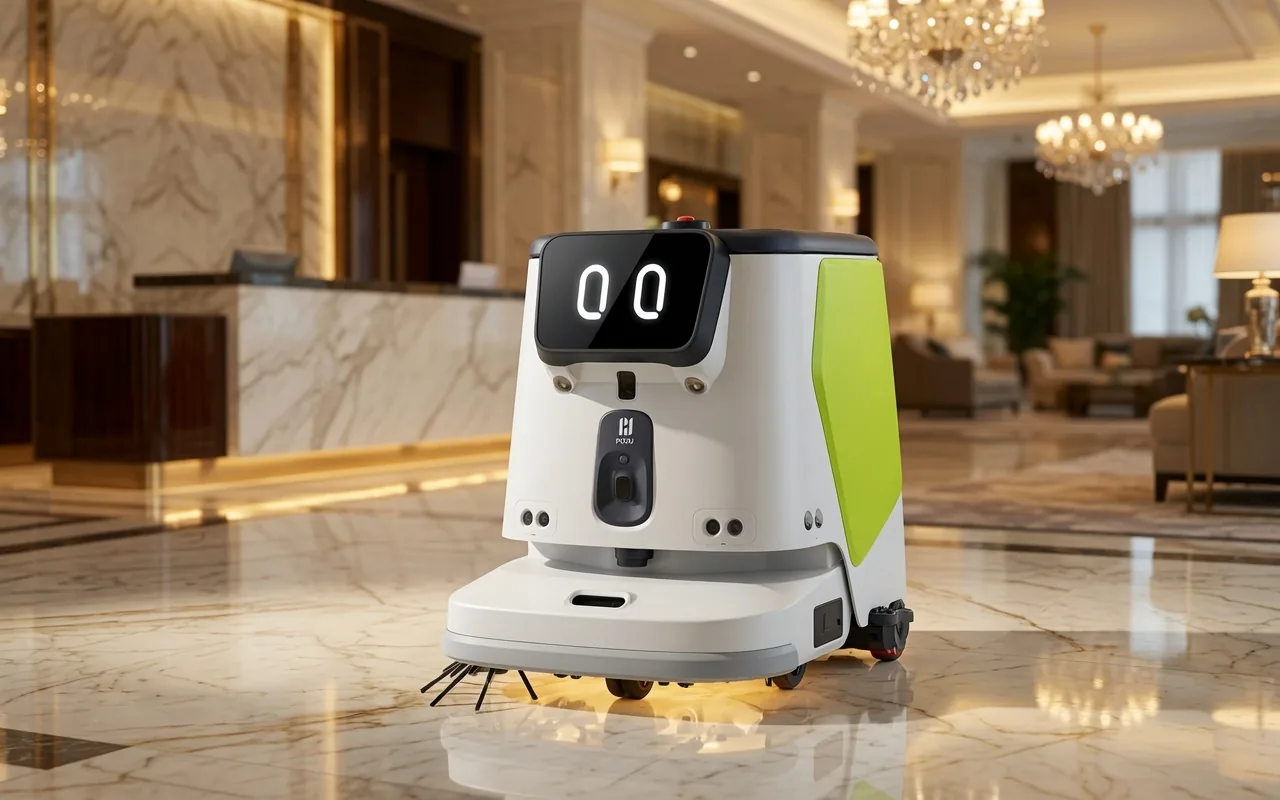
A commercial cleaning robot's true cost is four things (the machine, its docking station, the accessories your site needs, and ongoing consumables and service), and most operations set that total against the labor the robot redirects each month. What decides whether a robot pays for itself is the labor it redirects, the hours it runs, and how the cost is structured against that value over months and years. Here is how to think about it honestly, without getting lost in spec sheets or marketing math.
The real components of commercial cleaning robot cost
There are four pieces to a fair commercial cleaning robot cost calculation. The machine itself, the docking station, the accessories you actually need for your site, and the ongoing consumables and service. For the PUDU CC1 Pro that means the price of the unit, the Self Cleaning Docking Station, optional accessories such as an Elevator IoT Module or an additional battery, and a planned schedule of brushes, filters and squeegee blades over the life of the machine.
That total is meaningful, but it is not the number that decides whether to buy. The number that decides is what it returns. A robot that runs an overnight shift, with the dock handling its own water and cleaning between cycles, redirects far more labor than one that needs a person to start, refill and clean it.
How most facilities actually pay
Few operations write a single check for a fleet, and none of our customers needs to. Most finance their robots through a bank or lender, which turns a large one-off purchase into a predictable monthly cost. That monthly figure can then be set directly against the labor value the machine returns each month, which is how the decision becomes a financial one rather than a leap of faith.
Tovrana prepares the full proposal for that, including pricing, the machine's specifications, and an honest return projection, and we walk it through lender approval with you. Approval typically takes 5 to 10 business days. That is usually faster than the internal procurement cycle on the customer side, so finance is rarely the bottleneck.
A simple way to test the math
Take the cleaning hours a robot would cover each month, multiply by your loaded labor cost per hour, and compare to the monthly finance figure. If the labor value is comfortably above the finance cost, the decision is straightforward. If it is close, the dock, accessories and additional shifts often tip the balance, because each one extends the unattended hours. If the labor value sits below the finance cost, the site is probably not yet the right fit, and we will say so.
Match the machine to the work, not the other way round
There is no single right robot, and the wrong one is expensive even at the right price. The CC1 Pro is the flagship because it does the most in one unit across mixed surfaces, which suits most hospitality, healthcare and corporate floors. For larger open floor at scale, the MT1 range handles sweeping and vacuuming. For delivery led operations, a BellaBot Pro or KettyBot Pro is usually the better first machine. Our PUDU CC1 Pro review covers the flagship in detail, and the robots page lays out the rest.
The proper audit sizes the machine to your space rather than selling you more robot than your floors need. That audit is part of the proposal.
Buying outright versus financing
Both options exist. Buying outright suits operations with capital available and a long horizon on the same hardware. Financing suits almost everyone else, because it keeps the monthly cost predictable, leaves capital free for elsewhere, and makes it easier to plan around upgrades as the technology improves. For most of the customers we speak to, the right question is not whether to finance, but which finance term aligns the monthly figure with the labor value the robot returns.
There can also be tax timing to consider, and your accountant is the right person to confirm what applies to your business. Worth raising automation with them as part of annual planning rather than mid-year.
The cost of waiting
There is one number that rarely makes it onto a spreadsheet, and it is the cost of doing nothing. Every month of unfilled vacancies, paid overtime to plug rota holes, and inconsistent cleaning is a real cost too. We are not suggesting urgency for its own sake, only that the comparison is not "robot versus zero." It is "robot versus the cost of the current arrangement." That second number is usually higher than people expect. The labor angle is covered in more depth in our piece on cleaning robots and the labor shortage.
Frequently asked questions
What does a commercial cleaning robot cost?
The PUDU CC1 Pro is the flagship, with the Self Cleaning Docking Station as a strongly recommended add on. Pricing is available on request, and most operations finance both rather than purchase outright, which spreads the cost into a predictable monthly figure.
How long does finance approval take?
Usually 5 to 10 business days. We prepare the full proposal, pricing, specifications and ROI projection, so the lender has everything they need up front.
Can one robot cover my whole facility?
Often, yes. A single CC1 Pro covers 5,000 to 8,000 square meters per charge. Larger or more complex sites may benefit from more than one machine, which is what the audit is for.
What are the ongoing costs after purchase?
Consumables (brushes, filters, squeegee blades) tracked against usage hours, plus electricity and water. We cover the maintenance side in our maintenance guide.
Do you help with the lender approval process?
Yes. We prepare the full finance proposal and assist you through bank or lender review. Most approvals come back inside two weeks.