Commercial cleaning robot safety is usually the first question a facility manager asks, and rightly so. A machine that works in lobbies, corridors, and wards has to share space with people who are not paying attention to it. Here is how a modern cleaning robot is built to do that safely, in plain terms.
Commercial cleaning robot safety starts with sensing
The CC1 Pro combines LiDAR for long range mapping with visual sensing for close obstacle recognition. Together these let it detect both fixed objects and moving ones, including low and thin obstacles that simpler machines miss, and hold a safe clearance as it works. This is what allows it to run in a live, occupied space rather than one that has been cleared first.
It slows and stops, it does not lurch
When something enters its path, the robot decelerates smoothly and stops, then resumes once the way is clear. The behavior is deliberately gentle rather than a hard brake, which matters in spaces with people nearby. As speed changes, so does the size of the safety margin it keeps around itself, so it always has room to stop comfortably.
The physical emergency stop
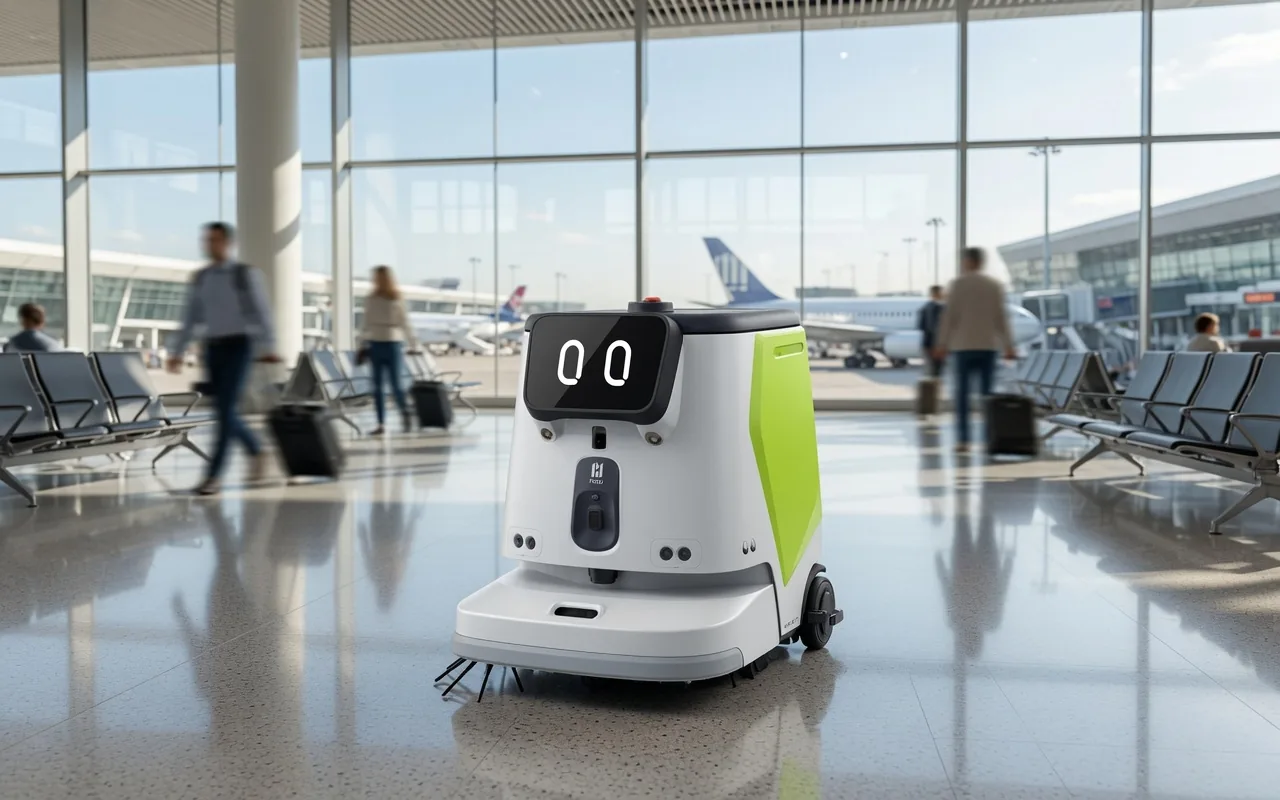
Software safety is layered, but there is also a hard fail safe. The CC1 Pro carries a prominent emergency stop button. Any staff member can press it to halt the machine instantly, and it stays stopped until a person resets it. Knowing that the manual override exists is usually what turns hesitation into confidence.
Signaling its intent
Like a vehicle's indicators, the robot uses lighting to signal turns and movement, so people nearby can read what it is about to do. A machine that telegraphs its intentions is far easier to share a space with than one that moves unpredictably, and it is a small detail that does a lot for how comfortable staff and guests feel around it.
On the LiDAR itself
The laser sensing used for navigation is eye safe in normal operation. It is not visible and not harmful to people or pets. Combined with the obstacle detection and the emergency stop, the result is a machine designed from the ground up to work alongside people rather than behind a barrier. Our piece on how the robot navigates goes into the sensing in more depth, and the staff training guide covers how teams get comfortable with it.
Frequently asked questions
What if someone steps in front of the cleaning robot?
It detects the obstruction and slows or stops, then resumes once the path is clear.
Is the LiDAR safe for eyes?
The LiDAR used in these machines is eye safe in normal operation.